
By Peter Ndaa
● Nov 18, 2025At the 10th Africa Public Sector HR Managers’ Network Conference in Sierra Leone, I had the privilege of leading a presentation on Performance and Accountability Systems: Aligning Behaviours with Strategic Intent.
That discussion reaffirmed a deeper truth:
Culture doesn’t fail because people don’t care.
It fails because leaders confuse alignment with harmony.
We often try to make everyone agree — to keep things smooth and comfortable.
But alignment doesn’t mean agreement.
It means holding the right tension — between performance and accountability — and managing it productively.
Strategy doesn’t live in plans, KPIs, or scorecards.
It lives in people — in the choices they make, the habits they form, and the actions they take when no one is watching.
And when we fail to measure what drives those behaviours, culture quietly drifts off course.
We measure performance — outcomes, impact, and numbers —
but we rarely measure behaviour.
When behaviour goes unmeasured, the natural tension between learning and delivery turns toxic.
Without visibility, culture becomes vague.
And accountability becomes emotional rather than evidence-based.
Performance and Accountability are often described as complementary.
But that framing hides the truth.
They’re not harmonious partners — they’re a productive paradox.
They pull in opposite directions — yet they are interdependent.
Their tension isn’t a problem to solve; it’s a paradox to manage.
Great leaders don’t eliminate this tension.
They use it — to build capability and credibility, learning and delivery, improvement and results.
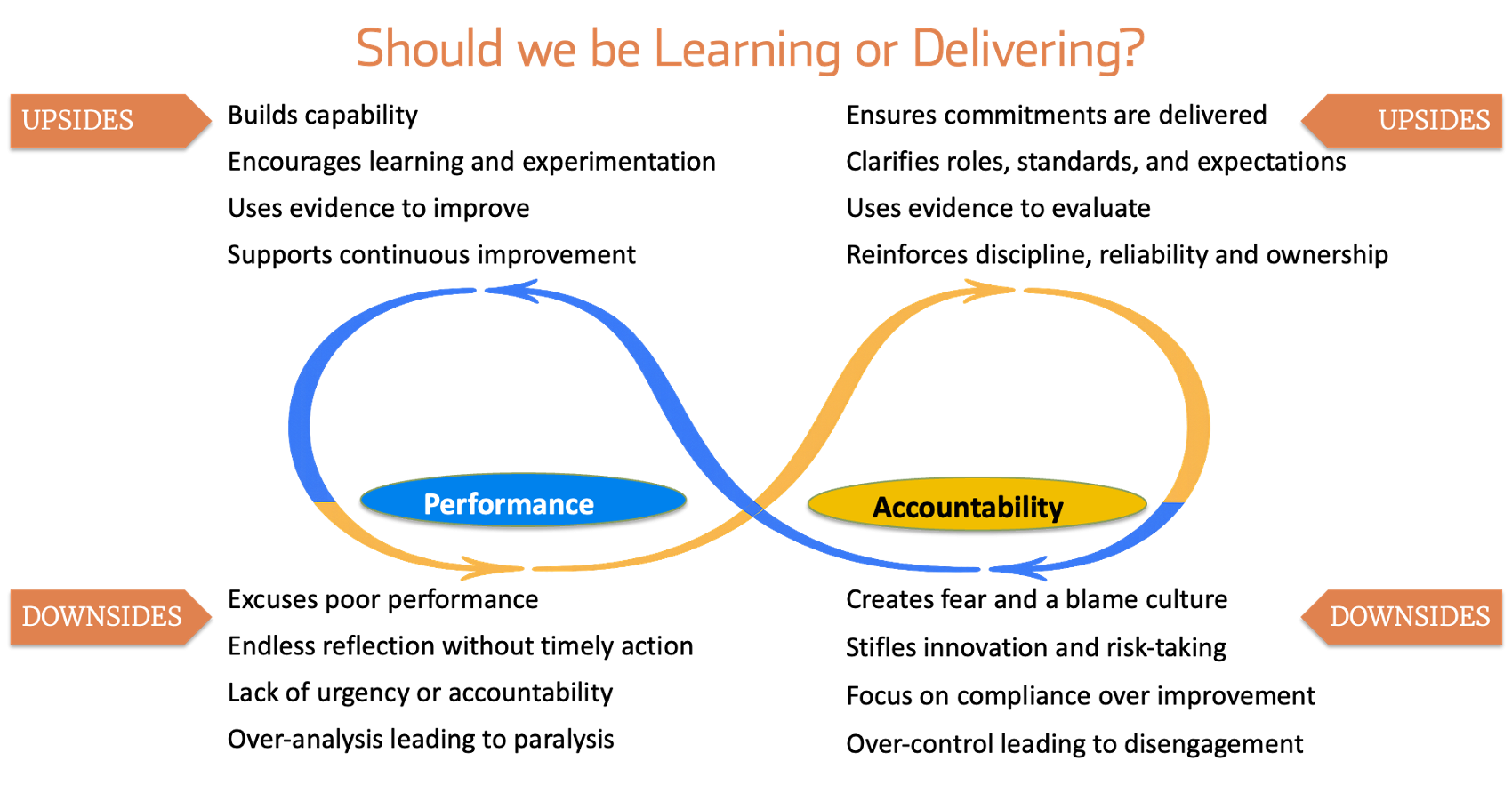
The bridge between Performance and Accountability is Behaviour.
Behaviour is where strategy becomes real.
It’s how people translate learning into delivery — and delivery back into learning again.
When we fail to measure behaviour, we break that bridge.
When we measure it, we align culture with strategy — connecting the intent of performance with the discipline of accountability.
This is where the Behavioural Complexity Matrix (BCM) becomes invaluable.
BCM helps leaders make the invisible visible — defining, observing, and measuring the behavioural complexity required for high performance.
It gives language to the continuity behaviours that maintain stability and the transformation behaviours that drive improvement.
Without evidence, behaviour stays invisible.
Culture turns into personality.
Feedback becomes opinion.
Improvement becomes optional.
The solution isn’t more slogans, values posters, or town halls.
It’s visibility.
We make behaviour visible when we measure both what people do — and how they do it.
This is the discipline that frameworks like PuMP bring.
PuMP helps teams build evidence-based performance systems that connect results, processes, and behaviours — replacing vague judgement with clear data.
Behaviour lives in activity — in how people show up in their daily work.
We can measure it through two practical types of measures that make behaviour visible and align it with strategy:
Notice the connection:
The Quota Measure drives discipline and consistency,
while the Activity Measure ensures quality and productivity.
Together, they create a behavioural feedback loop — shaping habits and embedding accountability into daily work.
Quota measures shape discipline through task design.
Activity measures shape habits through system design.
Together, they make culture measurable.
High-performance cultures aren’t built by removing tension.
They’re built by refining it through evidence.
When all three connect, strategy becomes a living system — not a static plan.
Leaders who master this paradox turn measurement from a control tool into a cultural accelerator.
If performance lives in systems and accountability lives in people,
then behaviour is where your strategy truly comes to life.
What behaviour will you make visible next?